
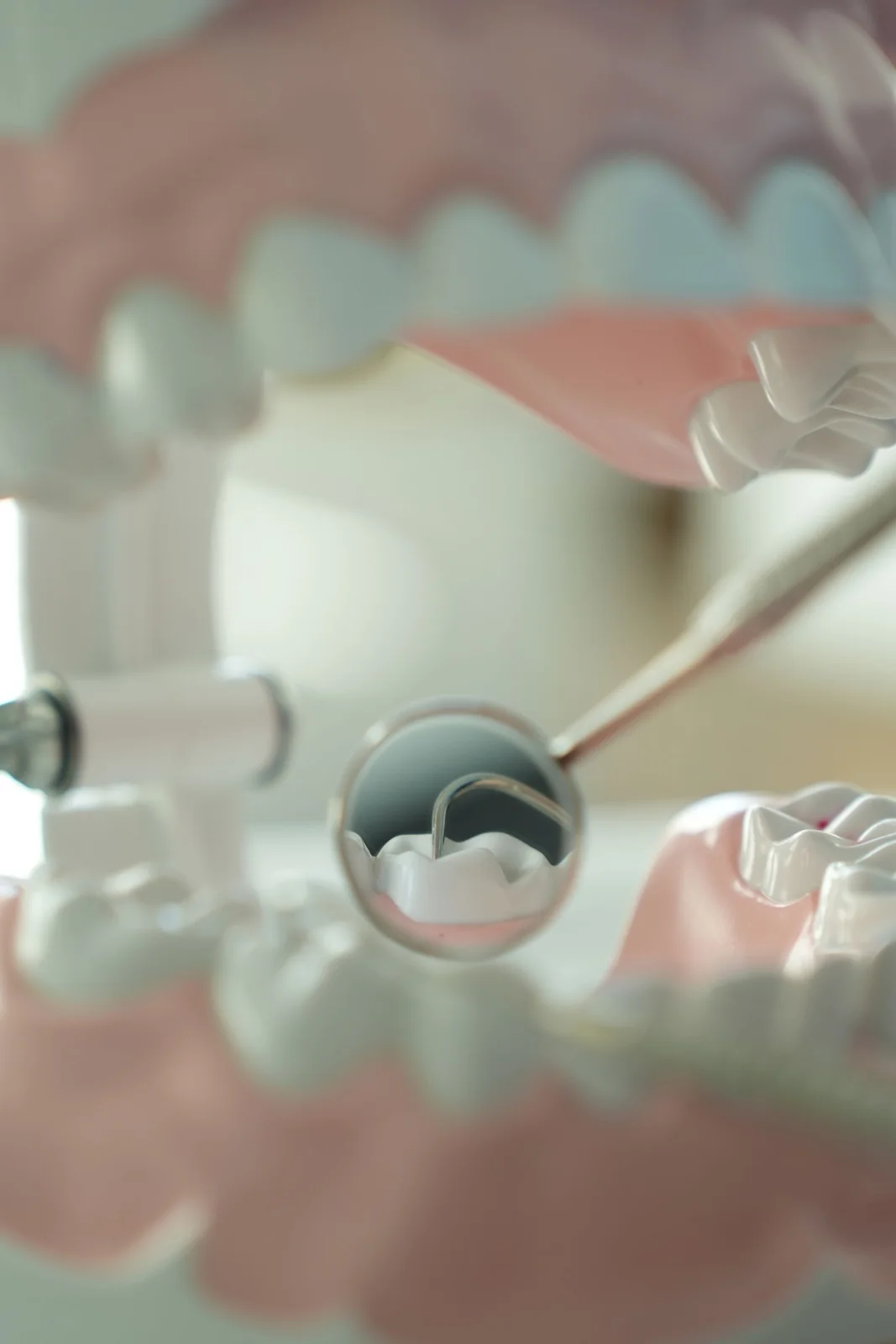
Stock photograph for illustration; not a participating clinic, practitioner, patient or treatment result. Photo: Busenur Demirkan / Pexels.
An implant supported bridge replaces two or more missing teeth using dental implants as anchors rather than relying on neighbouring natural teeth. Unlike a conventional bridge, the implants sit in the jawbone and support the bridgework directly — meaning adjacent healthy teeth do not need to be prepared or crowned to hold the restoration in place. Understanding the terminology before your consultation helps you ask sharper questions and interpret any written proposal you receive.
What the term ‘implant supported bridge’ actually means
A dental implant replaces a missing tooth root by integrating with the jawbone; it can then support a crown, a bridge or a denture superstructure. A bridge, in dental terms, is a fixed restoration that spans a gap — it has anchor points (abutments) and one or more artificial teeth suspended between them (pontics). When both anchor points are implants rather than natural teeth, the whole structure is described as implant supported.
So the phrase combines two distinct restoration categories: the implant hardware beneath the gum and the bridge prosthesis above it. Your treating dentist may use slightly different terminology — ‘implant-retained bridge’, ‘fixed implant bridge’ or similar — but the underlying concept is the same.
How an implant supported bridge differs from a tooth-supported bridge
A conventional tooth-supported bridge grinds down healthy adjacent teeth to create crowns that anchor the pontic. An implant supported bridge leaves those neighbours untouched because the implants themselves act as the abutment posts. The Australian Dental Association notes that crowns and bridges are different restoration categories and encourages patients to discuss the benefits of each option with their dentist before deciding.
Healthdirect Australia lists a ‘bridge supported by neighbouring teeth’ as one alternative worth raising with your dental professional — which confirms the two options are genuinely distinct choices, not interchangeable outcomes. Which option suits your specific bone volume, bite, budget and health history is a clinical judgement your treating practitioner makes after assessment.
Support and component questions worth asking
Arming yourself with specific questions before your appointment is worthwhile. Healthdirect Australia advises writing down questions and asking for explanations in plain language, covering options, risks, benefits and any clinical uncertainty.
Some questions particularly relevant to an implant supported bridge:
- How many implants will support the bridge, and why that number? The number of implants used depends on clinical factors including bone volume and the span of the gap — this is a question for your treating practitioner, not something a referral service can determine.
- What is the bridge superstructure made from? Materials vary (zirconia, porcelain-fused-to-metal and others). Ask what is being proposed and why.
- What connects the bridge to the implants? The connection component is called an abutment. Ask whether abutments are included in the quote and whether they are custom or prefabricated.
- Is the bridge screw-retained or cement-retained? Each has practical differences in future maintenance and removal that your clinician can explain.
- What assessment is needed before treatment can begin? Healthdirect notes that gum and bone assessment, health history review and a treatment plan are all part of the process before placement.
- What are the realistic alternatives? Healthdirect lists removable dentures and conventional bridges as alternatives worth discussing. Some implant-retained dentures are also an option; the Australian Dental Association notes that dentures can be supported or retained by implants.
Hypothetical consultation scenario (illustrative only)
This is a hypothetical scenario to illustrate the value of prepared questions — it does not represent an actual patient.
Imagine a person attending an initial consultation for a three-tooth gap in their lower jaw. They arrive having written down five questions: what materials are proposed, how many implants are needed, whether neighbouring teeth will be affected, what the staged timeline looks like and what a full itemised quote covers. The clinician’s answers to those five questions immediately reveal whether the proposed plan involves two or three implants, what bone assessment is required, and how the total cost breaks down across stages. Without those questions prepared, a patient might leave with only a headline figure and no basis for comparing a second opinion.
See our guide to Multiple tooth implant consultation preparation for a broader list of appointment topics.
Understanding the written proposal or quote
Healthdirect Australia specifically advises patients to ask their dental professional to explain the whole quotation — which signals that itemised written proposals are normal and reasonable to request. When reviewing any written proposal for an implant supported bridge, it helps to identify whether the following are separately listed or bundled:
- Initial assessment, imaging (such as a cone-beam CT scan) and treatment planning
- Implant components (the implant body/fixture itself)
- Abutments
- The bridge superstructure
- Any preparatory procedures (bone grafting, extractions or gum treatment if required)
- Review appointments
If any of those items appear absent, ask whether they are included elsewhere or genuinely not required in your case. A proposal that shows each stage separately is easier to query and to compare if you seek a second opinion.
The Therapeutic Goods Administration’s consumer question guide for medical implants encourages patients to ask their health professional about expected costs, alternatives, risks and complications before proceeding — reinforcing that these are ordinary, expected questions rather than confrontational ones.
Checking your treating practitioner’s registration
Dental implant placement and prosthetic dental work is performed by registered dental practitioners. Ahpra and the National Dental Board maintain a public register of practitioners that you can search by individual name rather than by business name alone. Registration status can be verified at Ahpra.gov.au before or after any consultation.
What to do next
This guide is published by a referral website, not a dental practice. We do not assess suitability, interpret scans or recommend specific treatment plans — those decisions require a consultation with a registered treating practitioner.
If you are ready to connect with a provider in Adelaide who can prepare an assessment and written proposal, use our Multiple Tooth Implant Enquiries form to submit a consultation request. If your situation involves a single tooth or a full arch, our Single Tooth Implant Enquiries and Full Arch Implant Enquiries pages may be more relevant.
For a side-by-side comparison of implant-based and conventional bridge options, see our related guide: Dental implants compared with bridges — questions to ask.
Further reading
- Healthdirect Australia — Dental implant procedures and appliances: https://www.healthdirect.gov.au/procedures/dental-procedures-and-appliances/dental-implant
- Australian Dental Association — Crowns, bridges and veneers: https://teeth.org.au/crowns-bridges-and-veneers
- Therapeutic Goods Administration — Five questions to ask your health professional about a medical implant: https://www.tga.gov.au/resources/explore-topic/cosmetics/five-questions-ask-your-health-professional-you-get-medical-implant
- Ahpra Registers of Practitioners: https://www.ahpra.gov.au/Registration/Registers-of-Practitioners/Professions-and-Divisions.aspx
Sources and further reading
- healthdirect Australia — dental implant
- Australian Dental Association — crowns bridges and veneers
- healthdirect Australia — questions to ask your doctor
- Therapeutic Goods Administration — five questions ask your health professional you get medical implant
- Ahpra practitioner information — Professions and Divisions.aspx
Source links provide background, not an endorsement or clinical review of this page. Read our editorial approach.