
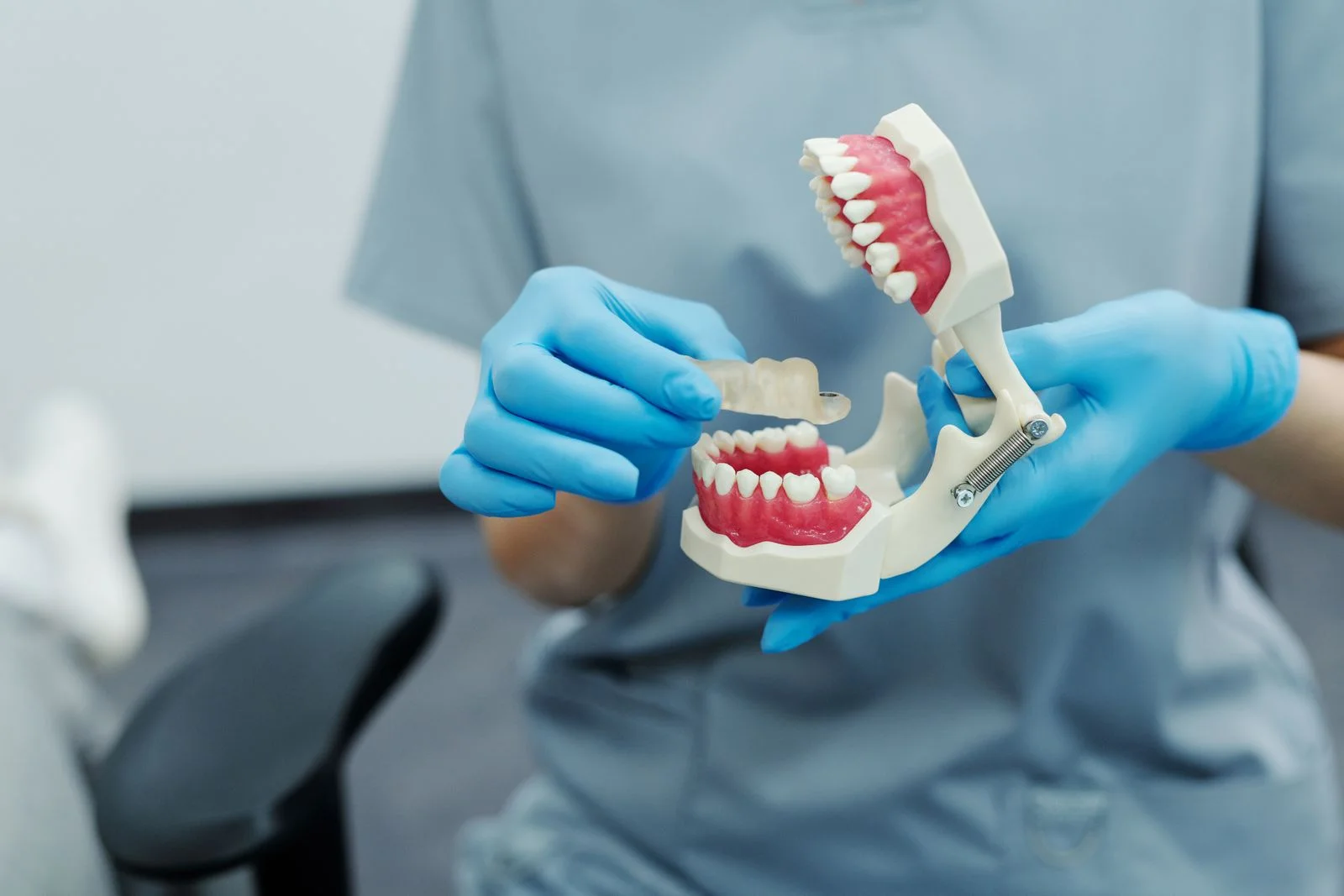
Stock photograph for illustration; not a participating clinic, practitioner, patient or treatment result. Photo: Cedric Fauntleroy / Pexels.
What a single tooth implant consultation actually involves
A single tooth implant consultation is a structured assessment appointment, not a sales visit. The treating dental professional reviews your health history, examines the gum tissue and underlying bone at the gap site, and determines whether further imaging or specialist referral is needed before a treatment plan can be prepared. Walking in with organised questions and relevant documents makes that conversation far more productive and helps you leave with a clear written scope to compare.
A dental implant replaces a missing tooth root — typically a titanium post placed into the jaw — and can then support a crown at the visible tooth level. Because bone volume, gum health and systemic health all influence whether the approach is appropriate for you, the treating practitioner will ask about existing medical conditions and current medicines before forming any view on suitability. That clinical judgement belongs with them, not with any referral or lead website.
Documents and information worth bringing
Arriving organised signals that you are a serious patient and saves consultation time:
- A current medication list, including supplements and over-the-counter medicines. Blood thinners, bisphosphonates and immunosuppressants are examples of categories a practitioner may want to know about — the specific relevance to your situation is for them to assess.
- Any recent dental X-rays or OPG (panoramic) scans from a previous dentist. These may reduce the need to repeat imaging on the day, though the practitioner may still request their own.
- A written list of your questions prepared before you arrive. Research from healthdirect Australia suggests writing questions down in advance and asking for explanations in plain language so you can follow the clinical reasoning rather than simply nodding.
- A note of your general dental and medical history, including previous extractions, gum disease treatment, or any diagnosed bone conditions.
- Your private health insurance membership details, if applicable, so the front desk can run a fund check.
The core clinical questions to ask
The TGA encourages patients to discuss alternatives, benefits, risks, expected costs and complications with the health professional before proceeding with any medical implant. Applied to a tooth implant consultation, this translates to a practical set of questions:
- Is my bone volume and gum health currently sufficient, or is preparatory treatment likely?
- What is the full sequence of appointments involved, and roughly what does each stage address?
- What complications are possible, and how are they typically managed?
- How does the implant option compare with alternatives at this site specifically?
- Will you provide a written itemised treatment plan I can take away?
- Are you a registered dental specialist for any component of this treatment, and can I verify that on the Ahpra register?
That last question is not about distrust — Ahpra maintains a public practitioner register that lets you independently confirm the named clinician’s registration category and status before proceeding.
Alternatives the consultation should cover
Healthdirect Australia identifies two main alternatives to a single dental implant: a removable partial denture and a tooth-supported bridge. A thorough consultation should give you enough information to understand how each option differs for your specific gap location.
Removable partial denture: A removable appliance that replaces the visible tooth. The Australian Dental Association notes that dentures — including those potentially supported or retained by implants — are a distinct restoration category. A conventional removable denture does not involve surgery but requires ongoing maintenance and may feel different in function compared to a fixed tooth.
Tooth-supported bridge: A fixed restoration that spans the gap by crowning the teeth on either side and suspending a false tooth between them. The ADA notes that crowns and bridges are different restoration categories from an implant. The practitioner can explain what preparing neighbouring teeth for a bridge involves in your particular case.
Asking the dentist to walk through the trade-offs of each option — not just present the implant as the default — gives you a basis for informed consent rather than assumed consent.
Understanding the written treatment plan
Healthdirect Australia advises patients to ask the dental professional to explain the whole quotation. A treatment plan for a single implant may involve multiple practitioners (for example, a surgeon for placement and a restorative dentist for the crown), multiple line items, and staging across several months. Before you leave the consultation, confirm:
- Whether the quoted amount is all-inclusive or whether items such as bone grafting, temporary restorations or follow-up visits are listed separately
- Which items, if any, may attract a private health fund rebate
- The sequence and approximate spacing of appointments
- What happens if additional preparatory work is identified during the process
For a detailed breakdown of what a written quote should contain, the guide on dental implant cost and written quote questions covers the line items worth reviewing. The single tooth implant cost questions guide addresses cost-specific preparation in more detail.
A hypothetical scenario: two patients, same gap, different preparation
This is a hypothetical illustration, not a customer story.
Imagine two people attending a single tooth implant consultation for a missing lower molar. The first arrives without records, can’t recall their medications and hasn’t thought about questions in advance. The practitioner spends part of the appointment reconstructing history and may need to defer a treatment plan pending records from the previous dentist.
The second arrives with a printed medication list, a copy of an OPG taken eight months earlier, and six written questions including one about alternatives. The practitioner can focus the appointment on clinical examination and planning, provide a written quote before the patient leaves, and give direct answers to the prepared questions. Same gap, same practitioner — meaningfully different consultation experience, and a clearer basis for a decision.
Verifying who you are seeing
Dental implant treatment may involve a general dentist, a periodontist, an oral and maxillofacial surgeon, or a prosthodontist depending on complexity. These are distinct registration categories. You can search the Ahpra practitioner register by the individual’s name to confirm their registration status and specialty. Search by the named person, not just the practice name.
Getting started with a consultation enquiry
If you are ready to connect with a dental provider in Adelaide to arrange a consultation, Single Tooth Implant Enquiries is the starting point on this site. If your situation involves multiple missing teeth, Multiple Tooth Implant Enquiries and Full Arch Implant Enquiries are also available.
For broader background before your appointment, the guides on what dental implants are and what a consultation establishes and dental implant components explained for a consultation provide useful grounding without substituting for clinical advice.
Further reading
- healthdirect Australia — Dental implant
- healthdirect Australia — Questions to ask your doctor
- Therapeutic Goods Administration — Five questions to ask your health professional before you get a medical implant
- Ahpra — Registers of Practitioners
Sources and further reading
- healthdirect Australia — dental implant
- healthdirect Australia — questions to ask your doctor
- Therapeutic Goods Administration — five questions ask your health professional you get medical implant
- Ahpra practitioner information — Professions and Divisions.aspx
- Australian Dental Association — crowns bridges and veneers
- Australian Dental Association — dentures
Source links provide background, not an endorsement or clinical review of this page. Read our editorial approach.