
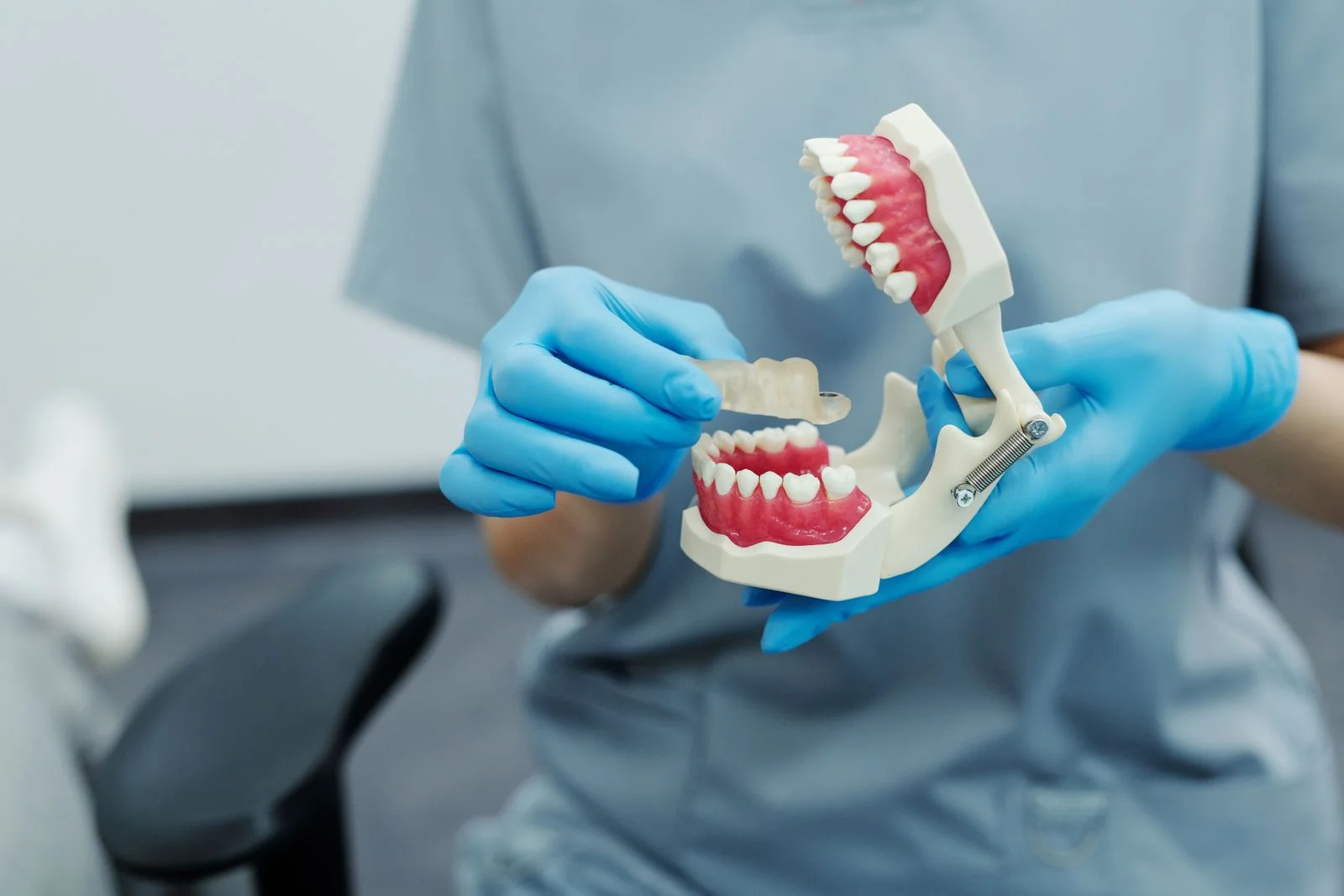
Stock photograph for illustration; not a participating clinic, practitioner, patient or treatment result. Photo: Cedric Fauntleroy / Pexels.
What do temporary teeth actually mean in an implant plan?
When a dentist proposes a multi-stage implant plan, temporary teeth refer to provisional restorations—placeholders that occupy the gap while the implant integrates with the jawbone. They are not the final crown, bridge or implant-supported denture; they serve a holding function during a treatment period that, depending on individual circumstances, may span several months. Understanding what has been proposed, what that provisional covers and whether a same-day arrangement is genuinely on the table are the three most important areas to clarify before you commit to a plan.
What is actually being proposed when a dentist mentions temporaries
A dental implant replaces a missing tooth root, and an assessment is required before any treatment decision is made. That assessment looks at gum health, available bone and overall health history. What comes between extraction (if needed) and fitting of the final restoration depends heavily on what that assessment finds.
Temporary teeth in this context might mean:
- A removable interim partial denture — a removable plate covering the gap, often called a “flipper” colloquially, which the patient takes in and out.
- A temporary crown on a healing abutment — a fixed provisional attached to the implant post, worn during the osseointegration period.
- A provisional bridge — spanning a gap using adjacent teeth or implants as anchors while final components are being fabricated.
These are genuinely different arrangements with different care requirements and different aesthetics. Healthdirect notes that alternatives to implants include removable dentures and bridges supported by neighbouring teeth, which is a useful frame for understanding why the type of temporary matters: it may preview the final restoration category, or it may not resemble it at all.
Ask the dentist: What type of provisional is proposed, and is it fixed or removable?
What the temporary is—and is not—included in your quote
One of the most common points of confusion patients raise before their consultation is whether the provisional is priced into the quoted figure or billed separately. Healthdirect specifically recommends asking the dental professional to explain the whole quotation before proceeding.
A written treatment plan should distinguish:
- The implant fixture placement procedure
- Any bone grafting or augmentation (a separate procedure when required)
- Healing abutments and cover screws
- Provisional restorations (temporary crown, temporary denture or other placeholder)
- Final abutment and final restoration (crown, bridge or denture)
If the quote lists “implant and crown” without specifying where provisionals sit, that ambiguity is worth resolving in writing before work begins. The TGA encourages consumers to ask about expected costs at each stage of a procedure involving a medical implant.
See our guide to dental implant cost and written quote questions for a more detailed breakdown of what a written quote should address.
The “no same-day promise” problem
Some practices market same-day teeth, teeth-in-a-day or immediate provisional loading. These phrases describe a specific clinical approach where a temporary restoration is placed at the same appointment as implant surgery, rather than waiting weeks before anything sits in the gap. It is a legitimate technique used in appropriate clinical situations, but it is not universally suitable—and marketing language does not equal a clinical guarantee.
Whether immediate provisionalisation is appropriate depends on factors the dentist can only assess during examination: bone density and volume, gum condition, bite forces and the number of implants involved. What is advertised on a website and what is clinically indicated for your jaw may be different things.
If a plan has been pitched to you that includes same-day temporaries, useful questions for your consultation include:
- Is same-day loading planned for my case, or is a healing period required first?
- If I cannot have immediate loading, how long will I be without a tooth or with only a removable plate?
- What restrictions apply to the temporary — can I eat normally?
A hypothetical scenario to illustrate the difference
The following is a hypothetical planning scenario, not a patient account.
Imagine two people attending consultations for a single missing upper front tooth. Person A has sufficient bone and healthy gums; the dentist proposes placing the implant and fitting a temporary crown the same day, with the final ceramic crown delivered after several months of integration. Person B has experienced some bone loss and requires a graft first; the dentist recommends a removable interim plate for three to four months while the graft heals, then implant placement, then a further healing period before a final crown. Same end goal; significantly different provisional journeys. Neither person could have known which path applied to them from a website alone.
This illustrates why a detailed consultation—not a quote over the phone—is the appropriate starting point.
Questions worth writing down before your appointment
Healthdirect recommends writing down questions before a healthcare appointment and asking for explanations in plain language. For temporary teeth specifically, consider preparing:
- Is the temporary fixed or removable?
- Is the cost of the temporary included in the quoted figure?
- How long is the temporary worn before the final restoration?
- What can and cannot be eaten while wearing it?
- What happens if the temporary breaks or becomes loose?
- Will I need to return for adjustments, and are those visits included?
- Does wearing the temporary affect the timeline for the final restoration?
Bringing this list to a first consultation means you leave with specific, written answers rather than general impressions.
How temporaries relate to the broader implant component sequence
Understanding what temporaries are becomes clearer when you understand the components that make up an implant restoration as a whole. The implant fixture is the titanium post placed in the bone. Above it sits an abutment—a connector piece—and above that is the final crown, bridge or denture. A temporary occupies the crown position during healing; it does not affect the fixture or abutment permanently.
Our guide to dental implant components explained for a consultation walks through each part in more detail, which helps clarify why the provisional phase exists as a distinct stage rather than a shortcut.
If you are planning for a full arch rather than a single tooth, the provisional question becomes more complex. Arch-level provisionals can serve as a diagnostic tool to refine aesthetics and function before final materials are chosen. That conversation is worth raising explicitly in a full arch consultation. See Full Arch Implant Enquiries if that is relevant to your situation.
Preparing to request a consultation
This site connects people with dental implant providers across Adelaide; we do not provide clinical assessments or treatment. For single-tooth scenarios visit Single Tooth Implant Enquiries; for plans covering more than one tooth, Multiple Tooth Implant Enquiries is the relevant starting point.
Before submitting an enquiry, reviewing our guide on what dental implants are and what a consultation establishes gives useful context on what to expect from that first appointment, including what information the dentist will need from you.
Further reading
- Healthdirect Australia — Dental implant procedures
- TGA — Five questions to ask your health professional before you get a medical implant
- Healthdirect Australia — Questions to ask your doctor
Sources and further reading
- healthdirect Australia — dental implant
- Therapeutic Goods Administration — five questions ask your health professional you get medical implant
- healthdirect Australia — questions to ask your doctor
Source links provide background, not an endorsement or clinical review of this page. Read our editorial approach.