
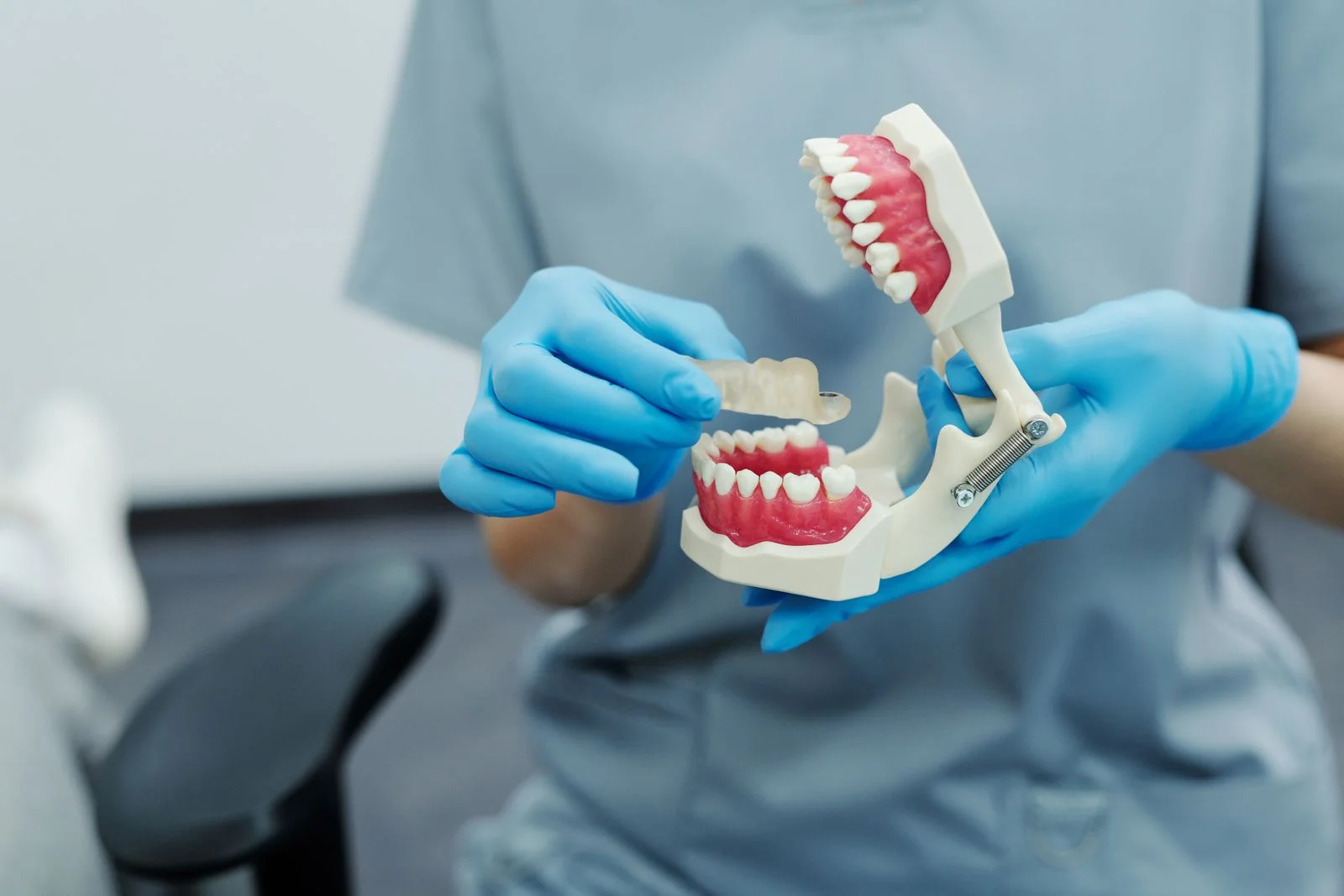
Stock photograph for illustration; not a participating clinic, practitioner, patient or treatment result. Photo: Cedric Fauntleroy / Pexels.
If you are considering dental implants, the condition of your gums is one of the first things a treating dental practitioner will want to understand. Arriving at a consultation knowing what to ask — and what information to bring — helps you have a more productive conversation and understand why certain assessments come before any treatment plan is discussed.
Why gum health matters in an implant assessment
A dental implant replaces a missing tooth root, with a crown, bridge or denture then attached above the gumline. Because the implant integrates directly with the jaw, the surrounding soft tissue and bone need to be in a condition that supports that process. The American Academy of Periodontology notes that the success of an implant is closely linked to the health of the surrounding gum and bone tissue, and that active gum disease needs to be addressed before implant placement is considered.
This does not mean that anyone who has ever had gum problems is automatically excluded from discussion — it means the practitioner needs an accurate picture before forming a view. That picture comes from a clinical assessment, not from an online checklist.
What the practitioner will want to assess
According to Healthdirect Australia, the treating health professional assesses gums and bone as part of the implant evaluation process, alongside asking about general health conditions and current medicines. The assessment is not simply visual. It typically involves measuring the depth of gum pockets around existing teeth, checking for signs of active infection or inflammation, and reviewing bone structure — often with imaging.
The practitioner is building a baseline. If they identify active periodontal disease, loose teeth, significant bone loss in the jaw, or uncontrolled systemic conditions that affect healing, these all become part of the treatment planning conversation rather than automatic disqualifiers. What they cannot work from is an incomplete history.
Information to bring to the consultation
The more accurately you can describe your gum history, the more efficiently the consultation can proceed. Consider preparing notes on the following before you attend:
- Any previous periodontal (gum) treatment — scaling, root planing, surgical procedures, or any diagnosis of periodontitis or gingivitis, and roughly when these occurred
- Current or past smoking history — smoking affects gum tissue and healing, and practitioners routinely ask about it
- Systemic health conditions — conditions such as diabetes are known to affect gum health and healing responses; your treating practitioner needs this context
- Current medicines — including prescription medications, over-the-counter products and supplements; some affect gum tissue directly or interact with procedures
- Any history of dry mouth — whether from medication or otherwise, as this can relate to infection risk
- Recent changes in gum appearance or sensitivity — bleeding on brushing, recession, shifting teeth, or persistent bad breath
Healthdirect Australia confirms the health professional will ask about health conditions and medicines as a standard part of the assessment process, so having this information ready rather than trying to recall it during the appointment improves accuracy.
Questions worth preparing before you attend
Healthdirect Australia recommends writing down questions before a healthcare appointment and asking for explanations in plain language. For a dental implant consultation focused on gum health, some useful questions to bring include:
- Do I currently have any signs of active gum disease, and would that need to be treated before anything else is discussed?
- If bone loss has occurred where the tooth is missing, what does that mean for the assessment?
- What imaging or further measurements do you need to form a treatment plan?
- Are there any health conditions or medicines I’ve mentioned that are relevant to the gum and bone assessment?
- What are the alternatives if my gum or bone condition affects the implant pathway? (Healthdirect notes that removable dentures or a bridge supported by neighbouring teeth are established alternatives.)
- What does the whole treatment sequence involve, and how many appointments might be needed?
The Therapeutic Goods Administration’s general consumer guide for medical implant discussions also suggests asking about risks, complications, benefits and expected costs — questions that apply directly to this type of consultation.
A hypothetical scenario to illustrate the difference preparation makes
This is a hypothetical example for illustration, not a real case.
Imagine two people attending an initial implant consultation on the same day. The first has not prepared and can only say they had “some gum treatment years ago” and cannot recall which teeth were involved or what was done. The second brings a note listing the year of their periodontist referral, the teeth that were treated, that they quit smoking three years ago, that they take a blood pressure medication, and that they have noticed some gum recession on a neighbouring tooth in the last six months.
The second person’s consultation can move further in the same appointment — not because their gum health is better, but because the practitioner has a more complete starting point for the clinical assessment and can prioritise which additional imaging or measurements are needed.
What you should not try to do before the appointment
There is no reliable way to self-assess gum or bone suitability for implants. Pocket depth, bone density and the presence of subclinical infection require instruments and clinical training to evaluate. Photographs, online symptom checkers and AI tools cannot substitute for this. If you have noticed symptoms — bleeding gums, loose teeth, visible bone changes — note these to report, but do not attempt to interpret them as either a clearance or a barrier.
Similarly, information from someone else’s implant experience, including timelines and costs, is not transferable to your situation. Healthdirect Australia notes that more than one appointment is typically involved and that a full treatment plan is developed through assessment — a plan that varies between individuals.
Verifying your practitioner’s registration
If you are arranging a consultation through any referral service, it is worth confirming the treating practitioner’s registration independently. Ahpra maintains a public register of dental practitioners and dental specialists that you can search by individual name. This is a straightforward step that applies regardless of how you found the practice.
Next steps for Adelaide residents considering an implant consultation
If you are preparing for a first conversation about dental implants, reviewing what a consultation typically covers can help you use that appointment well. See our guide to what dental implants are and what a consultation establishes for a broader overview, or single tooth implant consultation preparation if you are replacing one tooth.
For questions about what you might be quoted, the guide on dental implant cost and written quote questions explains what a written quotation should cover and what to ask if anything is unclear.
When you are ready to request a consultation enquiry, you can do so through our Single Tooth Implant Enquiries, Multiple Tooth Implant Enquiries or Full Arch Implant Enquiries pages depending on your situation.
Further reading
- Healthdirect Australia — Dental implant procedures and appliances
- American Academy of Periodontology — Dental implant procedures
- Therapeutic Goods Administration — Five questions to ask your health professional about a medical implant
- Ahpra — Registers of Practitioners
Sources and further reading
- healthdirect Australia — dental implant
- Professional dental information — dental implant procedures
- Therapeutic Goods Administration — five questions ask your health professional you get medical implant
- healthdirect Australia — questions to ask your doctor
- Ahpra practitioner information — Professions and Divisions.aspx
Source links provide background, not an endorsement or clinical review of this page. Read our editorial approach.