
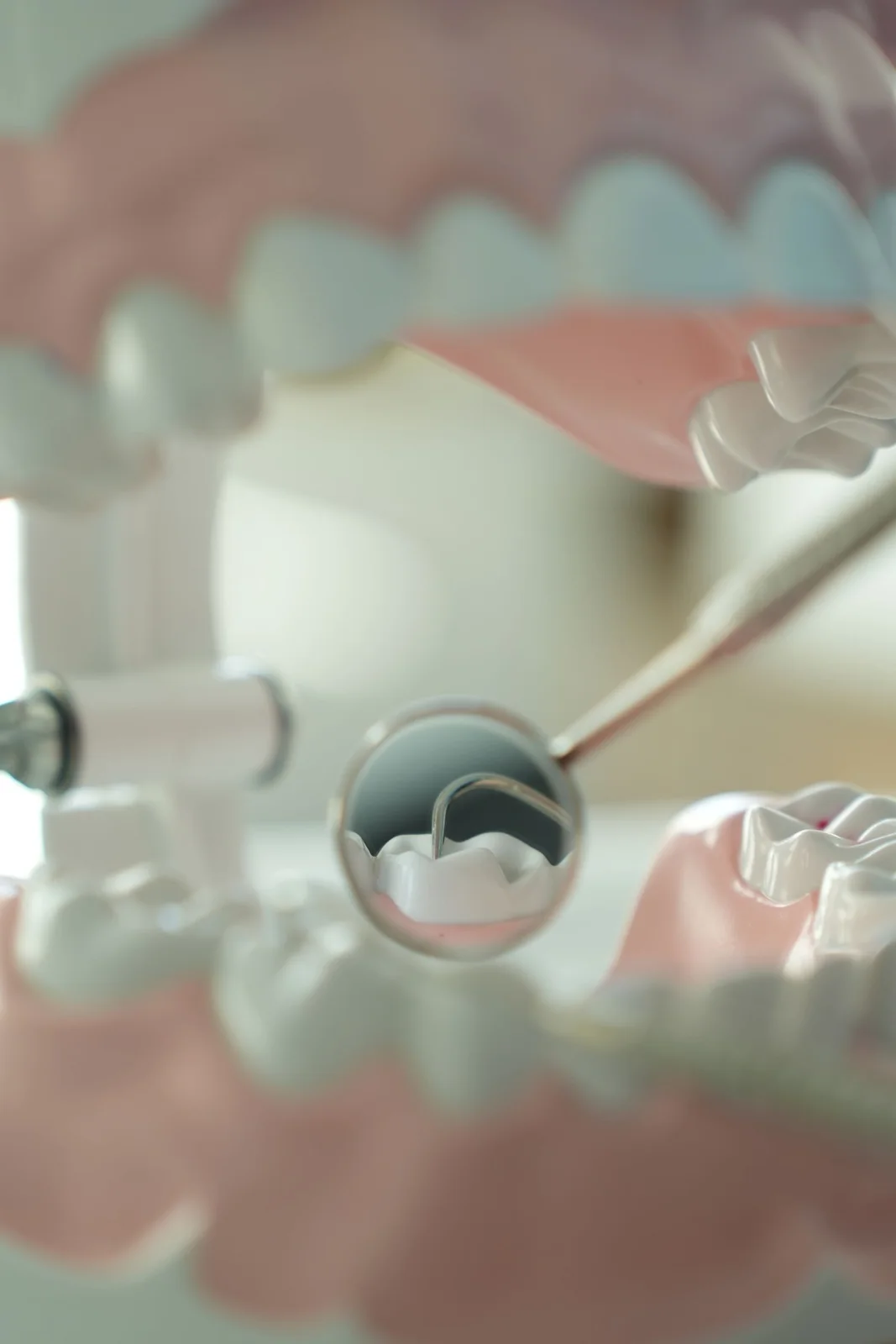
Stock photograph for illustration; not a participating clinic, practitioner, patient or treatment result. Photo: Busenur Demirkan / Pexels.
Implant retained dentures are a category of removable tooth-replacement prosthesis that clips or locks onto dental implants rather than relying solely on suction or adhesive against the gum. Understanding the terminology before your consultation means you can follow the dentist’s explanation, ask sharper questions, and leave with a clearer sense of your options — not just a price on a piece of paper.
What “implant retained” actually means
A conventional denture sits on soft tissue and, in the upper jaw, uses palatal suction to stay in place. An implant retained denture, by contrast, attaches to titanium posts that have been placed into the jawbone. The word retained refers specifically to how the prosthesis is held — by the implants — rather than by the ridge of gum underneath it.
This is different from an implant supported denture, a phrase you may also encounter. The distinction matters: a retained denture still distributes some chewing load to the gum, whereas a fully supported design transfers most of that load through the implants to the bone. Your treating dentist is the right person to explain which design is being proposed for you and why, based on your clinical assessment.
Healthdirect Australia notes that a dental implant replaces a missing tooth root and can be used to support a denture, among other restorations — and that a treatment plan and assessment of your gums and bone are required before any work begins.
Common prosthetic terms you will hear
Overdenture — the broader category name for a denture designed to fit over implants (or in some cases over retained natural roots). Most implant retained dentures are technically overdentures.
Locator attachment / ball attachment / bar attachment — these describe the mechanical system that connects the denture to the implant. The dentist or prosthetist chooses a system based on implant position, available bone, and the number of implants involved. Expect to hear one or more of these terms when the attachment design is described.
Abutment — the connector piece that sits above the gum line and links the implant fixture in the bone to the attachment or restoration above it.
Implant fixture — the titanium post that is surgically placed into the jawbone. It is not the same as the visible attachment or the denture itself.
Osseointegration — the biological process by which the jawbone bonds to the implant surface over a healing period. Treatment cannot proceed to the final denture stage until this process has occurred, which is why multiple appointments are always involved.
Flange — the pink acrylic border of a denture that extends along the gum. Some implant retained designs reduce or eliminate the flange, which can affect speech and aesthetics. This is worth discussing at consultation.
Chairside reline / laboratory reline — over time, the gum ridge under a removable denture may change shape, and the fitting surface of the denture may need adjustment. Understanding which type of reline your denture may eventually need helps you plan for ongoing care.
The Australian Dental Association notes that some dentures can be supported or retained by dental implants, and that any restoration may require further treatment down the track — making honest conversation about long-term maintenance important from the outset.
Fixed versus removable: understanding the category boundary
Implant retained dentures are removable — the patient takes them out for cleaning. This is different from fixed implant restorations such as bridges or full-arch frameworks that are permanently attached. If a provider’s materials use the phrases “snap-on”, “clip-on” or “stud-retained”, these are describing a removable implant retained prosthesis.
Fixed alternatives — sometimes called implant supported bridges or full-arch fixed restorations — are a separate category. See our related guides on fixed and removable implant options questions and All-on-Four terminology and consultation questions for more on those distinctions.
Questions worth preparing before your consultation
Healthdirect Australia recommends writing down questions and asking for explanations in plain language. The TGA similarly encourages patients considering medical implants to discuss alternatives, benefits, risks, expected complications and costs with their health professional before proceeding.
The following list is a hypothetical preparation scenario — not a clinical protocol — to illustrate the kind of groundwork that can make a first appointment more productive:
- What type of attachment system are you proposing, and why that system for my situation?
- Is this design retained, supported, or both — and what does that mean for how I chew?
- How many implants are involved in the plan you are quoting?
- What does the quote include — surgery, abutments, the denture itself, any temporary prosthesis during healing, and future relining?
- What happens if an attachment component wears and needs replacing?
- Will I need bone grafting or any preparatory procedure before the implants can be placed?
- Who carries out each stage — the same practitioner throughout, or a referral to a specialist for surgery?
- What are the alternatives if implants are not suitable or I choose not to proceed?
Healthdirect also notes that your health professional will ask about existing health conditions and medicines during assessment, so bring a current medication list to your first appointment.
Checking practitioner registration
Dental practitioners in Australia are registered through Ahpra and the relevant National Board. Before committing to treatment, you can verify an individual practitioner’s registration on the Ahpra public register — search by the person’s name rather than the practice name. Registration status is public information and an appropriate starting point for due diligence, though it does not constitute any endorsement by this referral website.
If a specialist title such as prosthodontist or oral and maxillofacial surgeon is used in a provider’s materials, that specialist registration can also be confirmed through Ahpra.
Understanding the quote you receive
Healthdirect recommends asking your dental professional to explain the full quotation so that every line item is clear. For implant retained dentures, a quote may legitimately span multiple stages: pre-surgical assessment, any preparatory procedures, implant placement, a healing period, abutment fitting, and fabrication and fitting of the final denture. A quote covering only one of these stages may appear lower than a comprehensive one — asking what is and is not included is not an unreasonable question.
If you are exploring options in Adelaide, our Full Arch Implant Enquiries service can help connect you with practices that handle implant retained denture consultations. You can also review our broader guide on full arch implant consultation questions for additional preparation material.
Related guides and services
- Fixed and removable implant options questions
- All-on-Four terminology and consultation questions
- All-on-Six terminology and consultation questions
- Full Arch Implant Enquiries
- Multiple Tooth Implant Enquiries
Further reading
- Healthdirect Australia — Dental implant: https://www.healthdirect.gov.au/procedures/dental-procedures-and-appliances/dental-implant
- Australian Dental Association — Dentures: https://teeth.org.au/dentures
- Therapeutic Goods Administration — Five questions to ask your health professional before you get a medical implant: https://www.tga.gov.au/resources/explore-topic/cosmetics/five-questions-ask-your-health-professional-you-get-medical-implant
- Ahpra Registers of Practitioners: https://www.ahpra.gov.au/Registration/Registers-of-Practitioners/Professions-and-Divisions.aspx
Sources and further reading
- healthdirect Australia — dental implant
- Australian Dental Association — dentures
- Therapeutic Goods Administration — five questions ask your health professional you get medical implant
- healthdirect Australia — questions to ask your doctor
- Ahpra practitioner information — Professions and Divisions.aspx
Source links provide background, not an endorsement or clinical review of this page. Read our editorial approach.